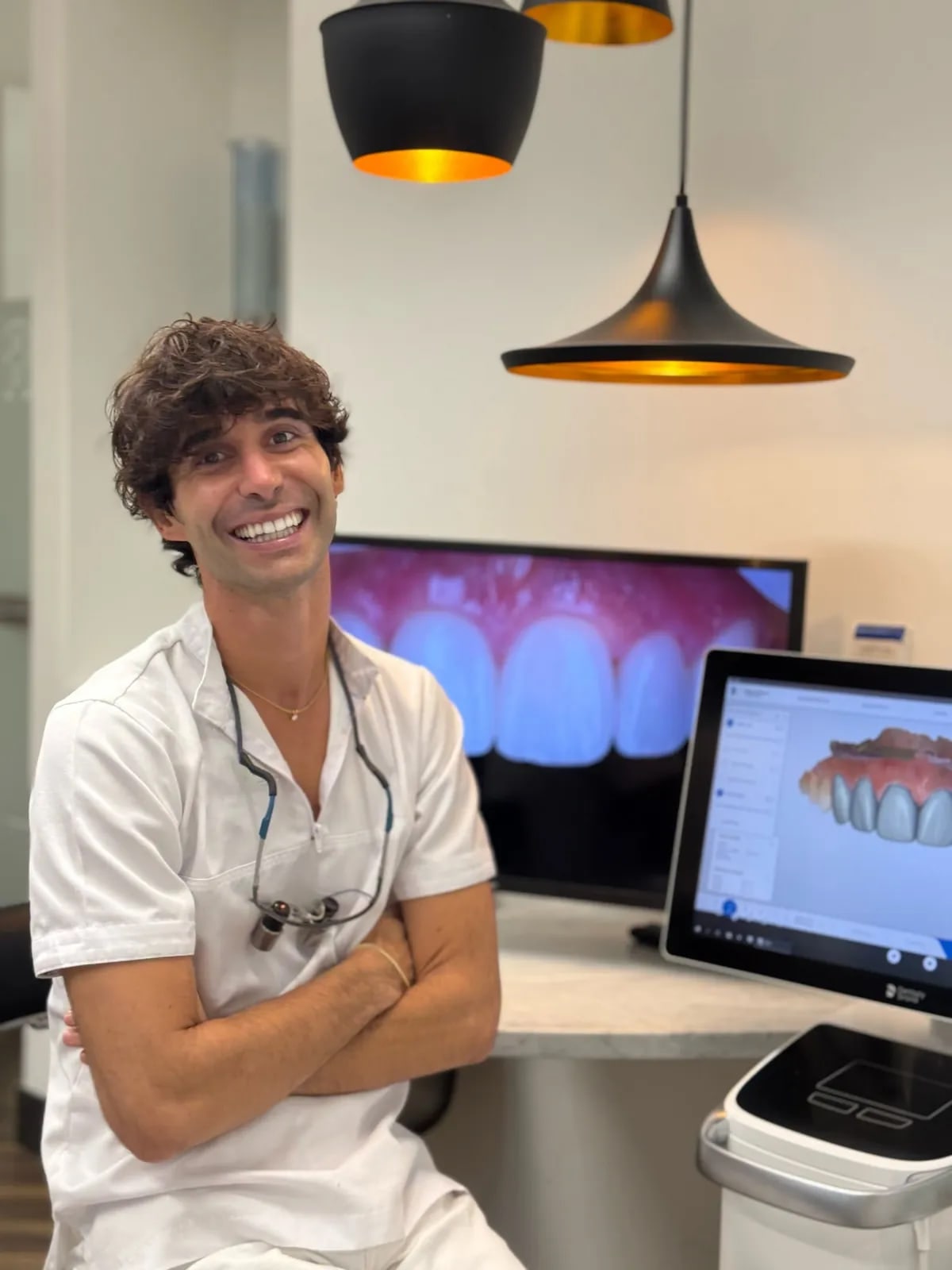
Dr. Victor Masip in the studio, beside an intraoral photograph and a CAD smile design on screen.

Amsterdam Veneer Studio

Natural porcelainveneers, designedand crafted byone doctor.

Dr. Victor Masip combines cosmetic dentistry, digital precision and hand-finished porcelain to create highly individual, natural-looking smiles.

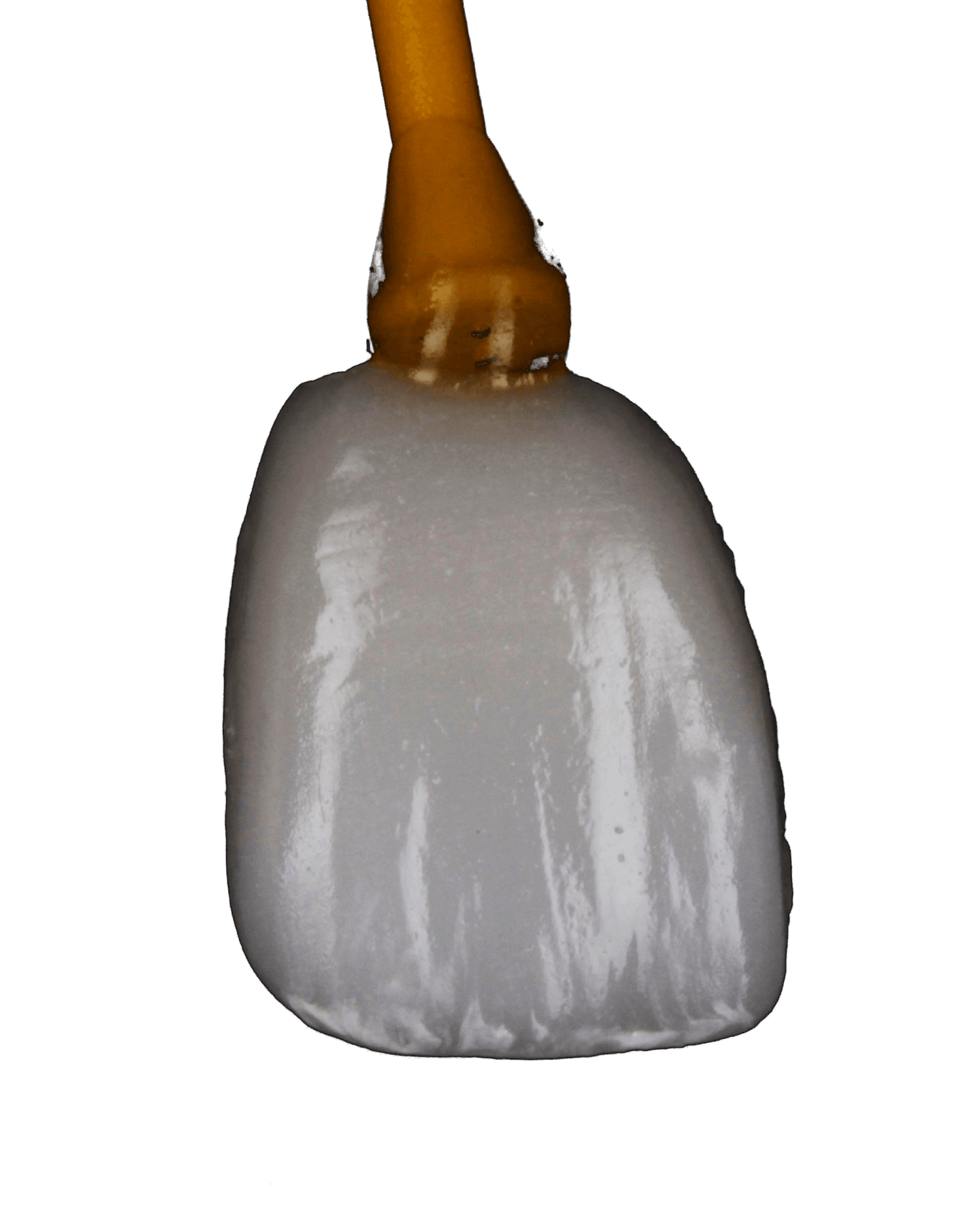
Close-up of a hand-finished E.max porcelain veneer on its modelling stick, showing the layered surface texture and the translucency of the fired ceramic.

The material

Ultra-thin.

Individually designed.

Hand-finished.

E.max.

E.max porcelain veneer, made in the studio

Every photograph on this website is genuine and unretouched. Clinical images are resized for the web but never altered. Photographs of porcelain shown before placement are the studio's own work and are not presented as patient results.

One doctor, complete control

From consultation to final porcelain,
every detail remains in the same hands.

There is no external laboratory and no handover. Dr. Victor Masip carries out the clinical assessment, the design, the milling, the glazing and the placement himself — so the intention behind a design survives all the way to the finished porcelain.

Designing the porcelain in the studio — the CAD stage, before anything is milled.
  1. 01Assess

    Clinical assessment

    Tooth position, gum health, bite and facial proportion are examined before any aesthetic plan exists. This is also where we establish whether veneers are the right route at all.

  2. 02Design

    Digital smile design

    A 3D scan and photographic series become the basis for a design built around your face, lips and natural tooth proportions — not a template.

  3. 03Craft

    Milled, glazed, characterised

    The porcelain is milled in the studio, then glazed and characterised by hand. Surface texture and translucency are adjusted under controlled light.

  4. 04Try in

    Seen before it is fixed

    The veneers are tried in without cement so shape, length and shade can be judged in your own face, in daylight, before anything is permanent.

  5. 05Place

    Final placement

    Bonding, finishing and bite refinement, followed by a review appointment to check comfort, function and gum response.

The treatment day

A complete transformation,
without weeks in temporary veneers.

  1. Beforehand

    Consultation and planning

    An assessment of 20 minutes. We look at tooth position, gum condition and bite, discuss what you want to change, and agree whether porcelain is appropriate — or whether something should be addressed first.

  2. Morning

    Preparation where clinically indicated

    Where tooth position and case selection allow, reduction can often be kept minimal. The amount of preparation is a clinical decision made per tooth, not a fixed promise.

  3. Morning

    Digital 3D scan and photography

    An intraoral scan and a calibrated photographic series capture the starting point and become the reference for the design.

  4. Midday

    Porcelain design and production

    Design, milling, glazing and characterisation happen in the studio while you take a break. This stage typically takes around three hours.

  5. Afternoon

    Personal try-in before cementation

    The veneers are placed without cement so you can see and approve them. Adjustments to shape, length or surface can still be made at this point.

  6. Evening

    Final placement

    Bonding, polishing and bite adjustment. On a full treatment day this stage usually concludes in the early evening.

  7. 1–2 weeks later

    Follow-up appointment

    A review of comfort, function, gum response and finish, with any refinement that is needed.

The porcelain is designed, produced and placed in a single day — there are no temporary veneers and no weeks of waiting. What the assessment determines is whether anything should be addressed before that day: in certain cases orthodontic treatment is recommended before veneers are considered.

Real transformations

Different faces.
Different smiles.
Never the same design twice.

Every design begins from a different face, a different lip line and a different set of natural proportions. What follows is documented work from the studio — shown as it was photographed, without retouching.

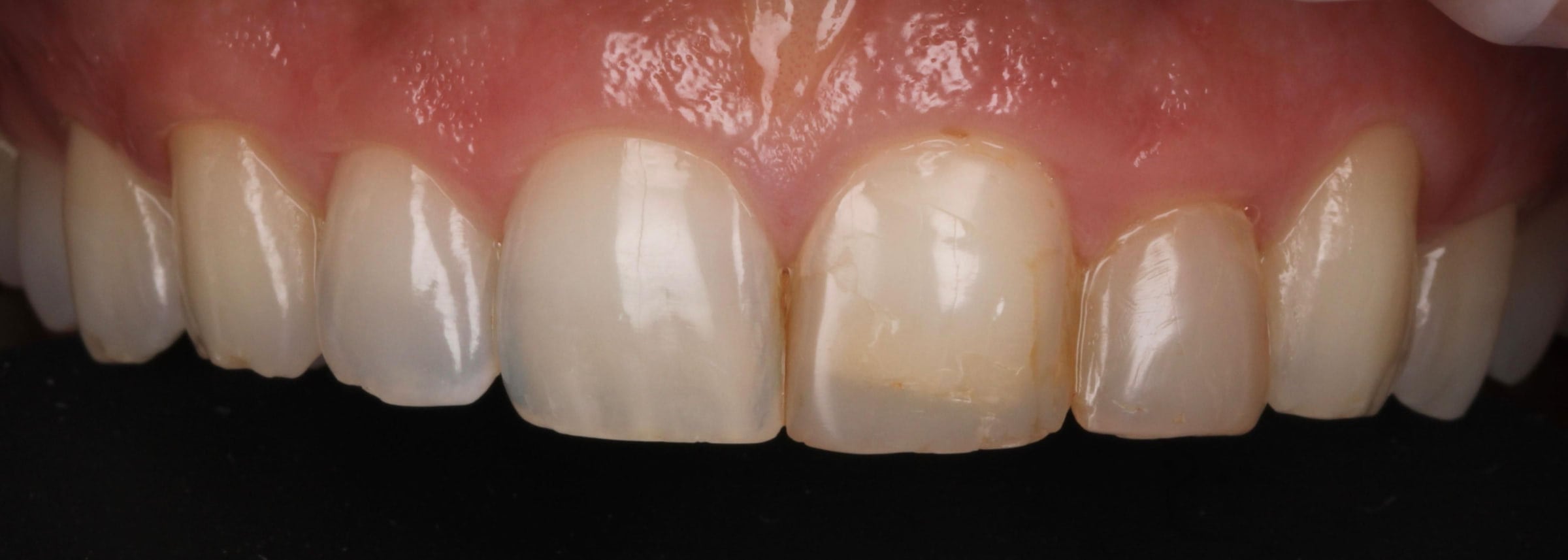
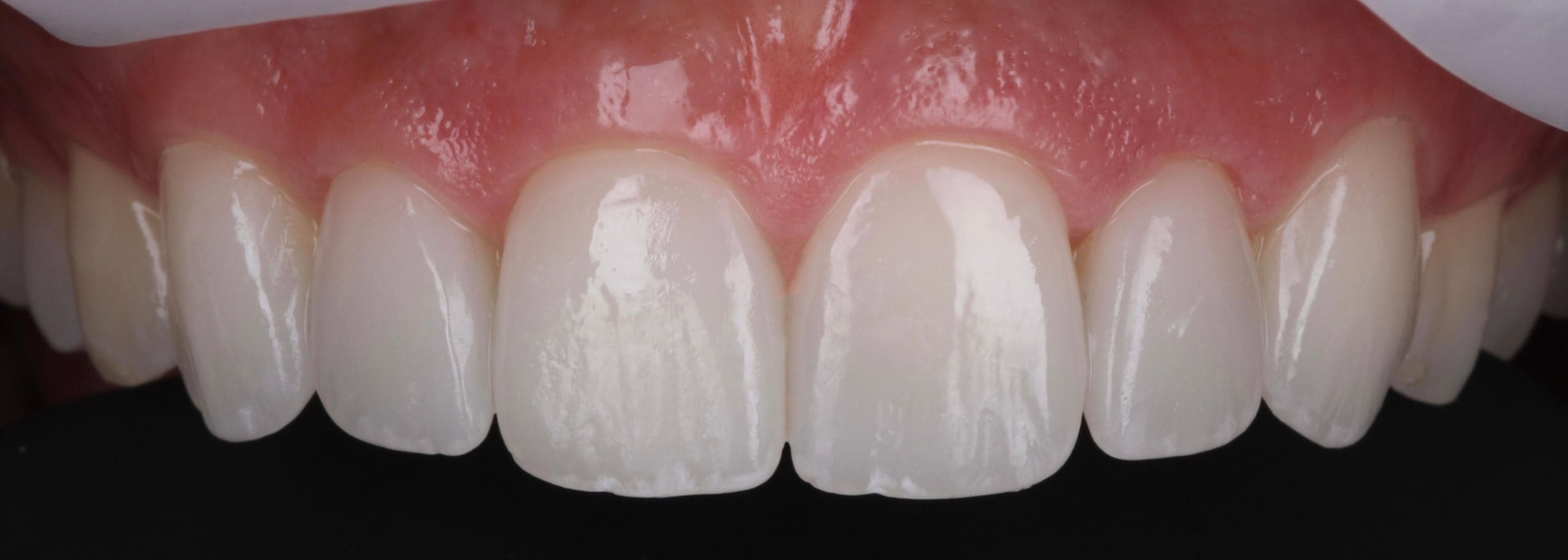
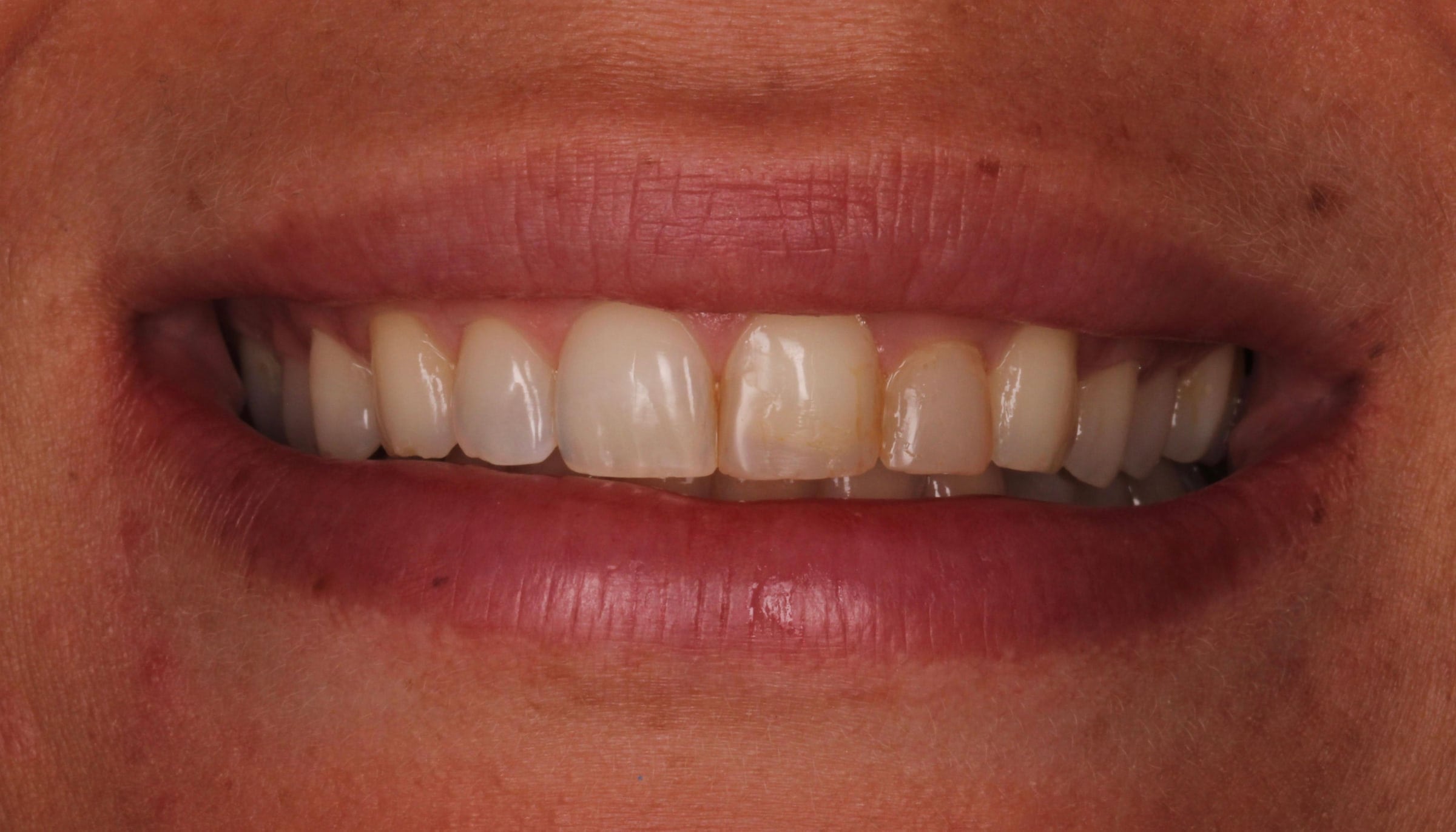
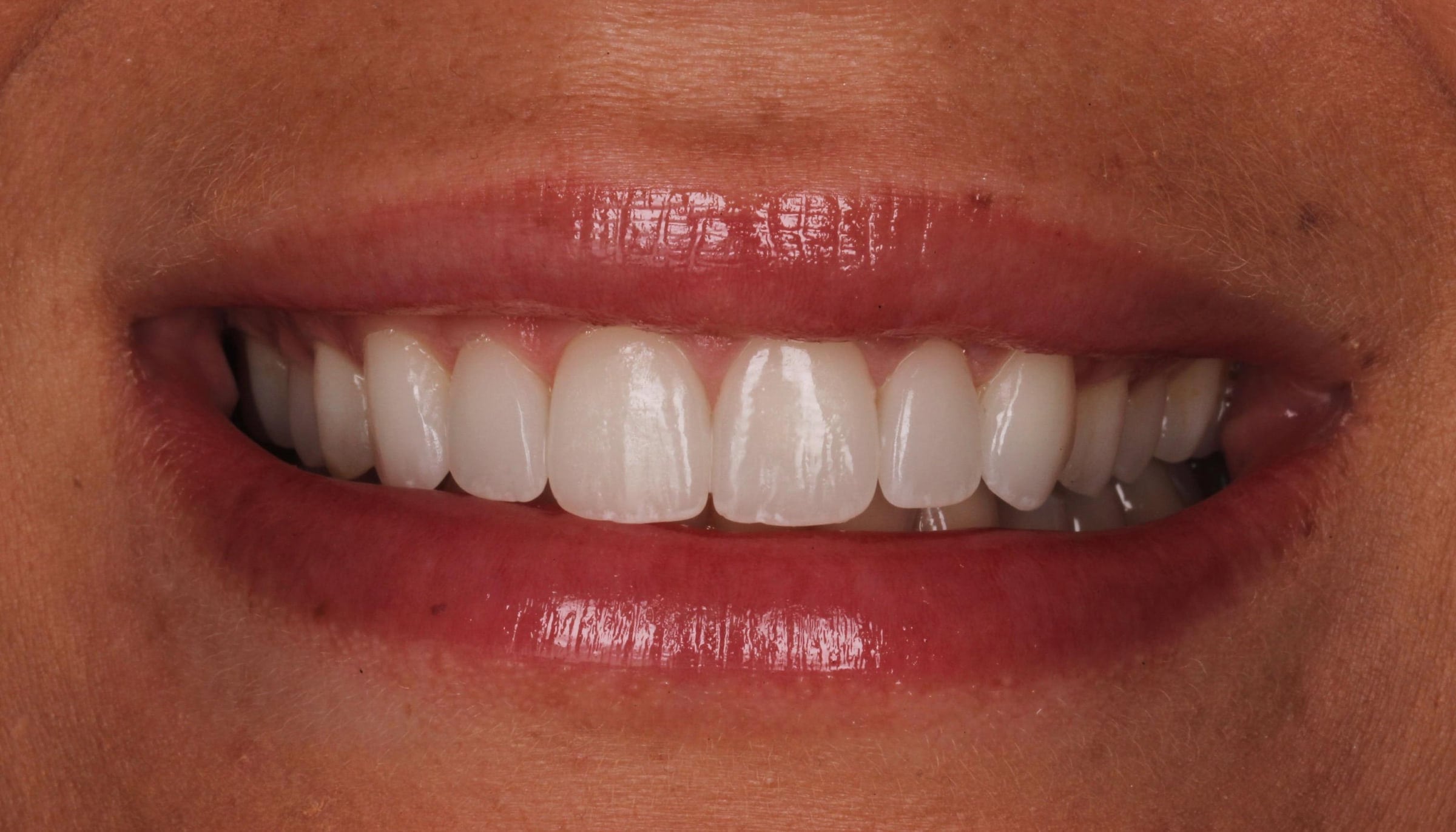
Case 01

Worn edges, restored proportion — from composite to porcelain

Treatment
Composite to porcelain
Retracted clinical photograph of the upper front teeth before treatment, showing worn incisal edges, uneven tooth lengths and a discoloured central incisor.
Retracted clinical photograph of the same upper front teeth after porcelain veneer treatment, showing restored edge length, even proportion and a uniform surface.
Anterior view. Retracted photograph of the upper anterior teeth. Drag the handle, or use the arrow keys, to move between before and after.
Close-up photograph of the patient's smile before treatment, with shortened, worn and unevenly shaded upper teeth.
Close-up photograph of the same patient's smile after porcelain veneer treatment, with restored tooth length and a more even, natural shade.
Smile view. The same treatment seen in the lips, photographed before and after. Both frames are shown at identical size so neither reads as larger than the other.

One case in full.The rest on Instagram.

The studio's complete portfolio is published on Instagram as cases are finished, rather than copied onto this page. That is where to look if you want to see the range of work.

See the full portfolio@amsterdam.veneer.studio

These are real, unedited photographs of treatment carried out at the studio. Clinical photography is resized for the web but never retouched. Results differ from person to person and depend on the starting situation, tooth position, gum health, bite and maintenance. Nothing shown here is a prediction of an individual outcome — suitability can only be established during a clinical assessment.

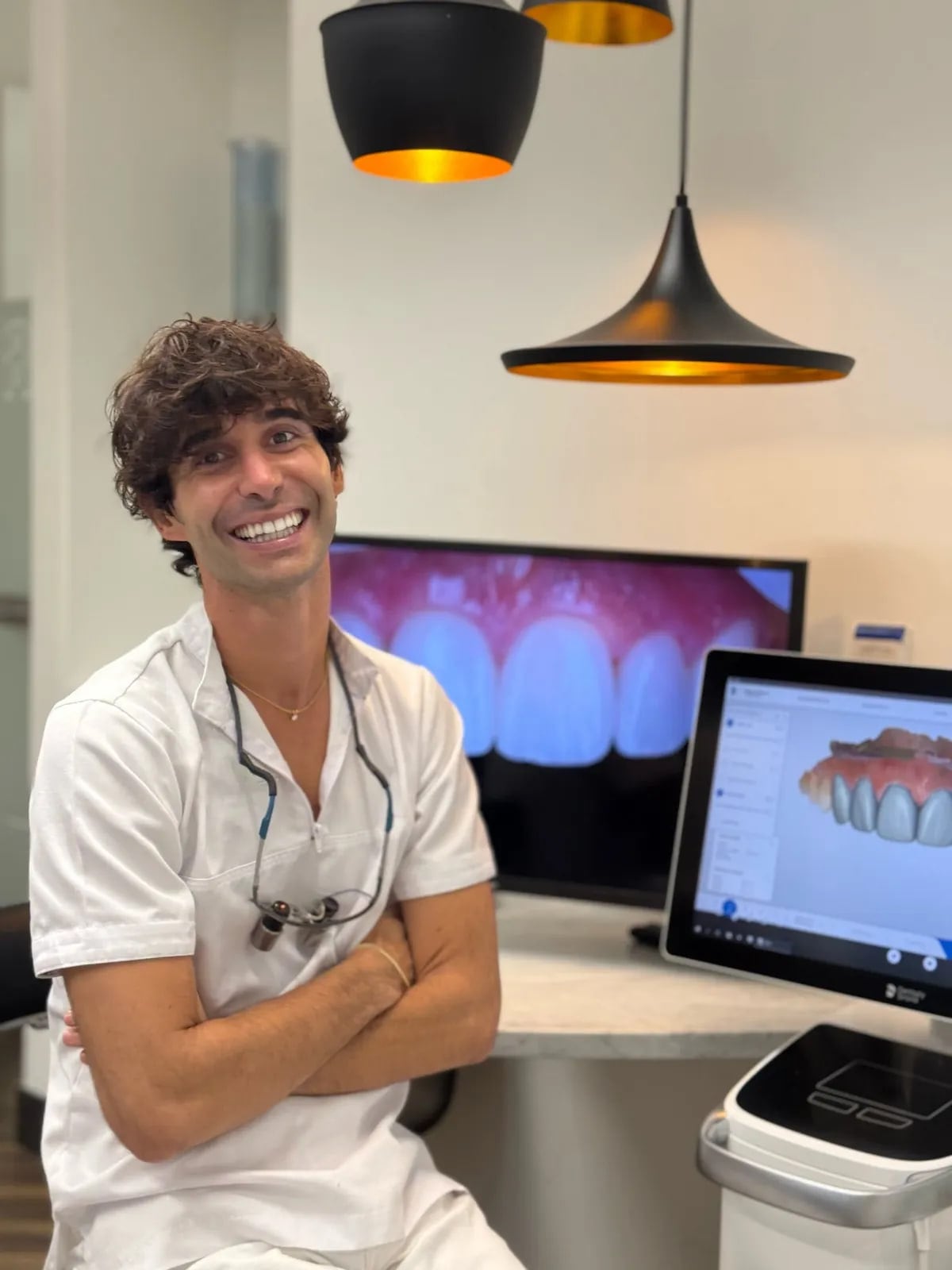
Dr. Victor Masip, Cosmetic Dentist & Porcelain Artist, in the studio.
Dr. Victor MasipCosmetic Dentist & Porcelain Artist
The approach

The approach

The best veneer is the one you do not notice.

Dr. Victor Masip — Cosmetic Dentist & Porcelain Artist

Veneers are not a substitute for orthodontics

When teeth are significantly crowded or rotated, moving them first protects tooth structure. Masking a position problem with porcelain usually costs more enamel than correcting it.

Healthy tooth structure is worth keeping

Enamel does not grow back. Where case selection and tooth position permit, reduction can often be minimised — and that decision is made tooth by tooth.

Harmony, not erasure

A good result should read as your own teeth on a good day. Character, proportion and small asymmetries are part of what makes a smile look real.

Porcelain is the standard — not composite

Porcelain is the closest material dentistry has to natural enamel. It transmits light the way enamel does, which is what gives depth instead of a flat white surface, and its hardness and polish behave like enamel under function. Composite is softer: it wears, absorbs stain and loses its surface, which makes it a temporary solution. That is a limitation of the material, not of the dentistry.

Dr. Victor Masip has worked in cosmetic dentistry for 14 years. Trained in Barcelona, further specialised in Amsterdam. He designs, mills, glazes and places the porcelain himself.

Suitability

Are porcelain veneers right for you?

Potentially appropriate

Porcelain veneers may be a sensible option when the underlying situation is stable.

  • Stable oral health, with healthy gums and no active disease
  • Tooth position that porcelain can work with
  • Aesthetic concerns porcelain can predictably address — shade, worn edges, shape, small spacing
  • Realistic expectations about what changes and what does not
  • Willingness to follow maintenance and review recommendations

Another step may be required first

These situations do not rule out treatment — they usually mean something should be addressed before porcelain is considered.

  • Active gum disease
  • Untreated decay
  • Significant crowding or rotation, where orthodontics is often the more conservative route
  • An unstable bite
  • A situation where a different treatment would achieve more with less intervention

This page cannot assess your teeth. It is general information, not a diagnosis, and it does not replace an in-person examination.

Discuss your situation during a consultation
Questions

What people ask before booking.

If your question is not answered here, send it to the studio and it will be answered directly.

Ask the studio
Are no-prep veneers always possible?
No — and it would be wonderful if they were, because preserving your own tooth structure is the whole aim. The limitation is physical. Porcelain is translucent, so to change the colour of a tooth it needs enough thickness to stop the underlying shade showing through; and to survive years of chewing it needs enough thickness not to fracture. A 0.1 mm shell can do neither. With E.max the practical minimum is around 0.5 mm at the thinnest point, and that is already pushing the material: the thinner you go, the more delicate the veneer and the less it can mask. Thickness also has to come from somewhere. If your teeth are already prominent, protruded or naturally large, bonding porcelain on top without creating space leaves them looking thick and bulky — the opposite of an elegant result. The genuinely no-prep case is one where volume actually needs adding: small teeth, angled inwards. In my experience that is perhaps one case in a hundred. So there is a small biological price. It is minimal and it is not dangerous, but it is real, and no marketing campaign changes it. What matters is a proper diagnosis, so the preparation is the minimum your case actually needs rather than a number promised in advance.
What is the difference between no-prep and minimal-prep veneers?
No-prep means nothing is removed — the porcelain is bonded onto the existing tooth surface. It only works when there is genuinely room to add volume, which is why it suits small or inward-angled teeth and very little else. Minimal-prep means a small, measured amount of enamel is removed to create exactly the space the porcelain needs: enough to mask the underlying colour, enough to sit flush with the gum and the neighbouring teeth, and enough thickness to be strong. The reduction is guided by the design rather than done freehand, and it stays within enamel wherever the case allows. The difference between the two is not a matter of philosophy. It is geometry — where your teeth already sit decides which one is possible.
Do porcelain veneers damage the underlying teeth?
Any veneer involves working on the tooth surface, so the honest answer is that it depends on how much is prepared and how well the case is planned. Where tooth position is favourable, reduction can be kept minimal and confined to enamel — which is precisely why position is assessed before anything else. Long-term tooth health also depends on the fit and margins of the restoration, on gum health and on your own maintenance.
Porcelain or composite — what is the difference?
Composite is a temporary solution. It is applied directly and it is cheaper, but it is a much softer material: it wears, chips, absorbs stain and loses its polish, and it typically needs renewing every few years. Porcelain holds its surface, its colour and its shape for far longer, and it transmits light in a way that is close to natural enamel. I no longer place composite veneers — not because composite dentistry is done badly, as there are colleagues who do it very well, but because of the material's own limitations. I do not offer patients something I would not want in my own mouth.
Why porcelain for full smile cases?
When enamel has already worn down, the restoration is doing structural work and not only cosmetic work. A softer material in that situation has a considerably shorter service life. For full cases the studio therefore works in E.max porcelain, which is suited to sustained function.
How does the one-day approach work?
Because there is no external laboratory. Design, milling, glazing, characterisation and placement are all carried out by Dr. Masip in the studio on the same day — which removes both the back-and-forth with a technician and the weeks in temporary veneers that normally come with it. You arrive in the morning and leave with the finished porcelain bonded in place. If the assessment shows something should be addressed first, such as orthodontic treatment, that happens before the treatment day is scheduled.
What does the treatment day involve?
It begins with the agreed preparation, followed by a 3D scan and photography. The porcelain is then designed and produced in the studio, which usually takes around three hours. You return for a try-in without cement, so shape, length and shade can be judged and adjusted before anything is fixed. Final bonding and bite adjustment follow, and a review appointment is scheduled one to two weeks later.
What do porcelain veneers cost?
A consultation is €30 and takes 20 minutes. Porcelain veneers are approximately €850 per veneer. The total depends on how many veneers are involved, the complexity of the case, and whether preparatory treatment is advised first. You receive a written estimate after your assessment, before anything is agreed.
How long do porcelain veneers last?
Porcelain is a durable material and well-selected cases can serve for many years, but longevity is not a fixed number. It depends on case selection, how much natural tooth structure remains, your bite, grinding habits, gum health, hygiene and regular review. Composite restorations generally have a shorter service life than porcelain. Any specific figure quoted without seeing your teeth should be treated with caution.
Do veneers look natural?
That is the whole intention, and it is largely a design question rather than a material one. Porcelain has a crystalline structure that transmits light similarly to enamel, which is what gives depth instead of a flat white surface. Whether the result reads as natural depends on how proportion, length, surface texture and shade are designed around your face and lips — which is why no two designs here are the same.
Is the treatment painful?
Treatment is carried out under local anaesthetic, and preparation is kept as conservative as the case allows. Sensitivity and discomfort vary between patients and depend on how much preparation was needed; some people notice temporary sensitivity afterwards. Your individual expectations are discussed beforehand so you know what is likely in your situation.
I am travelling to Amsterdam for treatment. How should I plan?
It starts with a digital consultation. You send photographs, we talk through what you want to change and whether porcelain is the right option for you, and you receive a written quotation. Once that is agreed we set the treatment day. Most international patients fly in the day before and stay in a hotel in Amsterdam, come to the studio in the morning, and leave the same evening with the finished porcelain in place. I like to see patients about a week afterwards to take the final photographs and check everything over, but for patients travelling from abroad that visit is not essential — the treatment itself is complete on the day.

The information on this website is general in nature and does not constitute medical advice or a diagnosis. Suitability for any treatment can only be established through an individual clinical assessment.

Book a consultation

Begin with an honest assessment.

A consultation is not a commitment to treatment. It is an opportunity to understand what is possible, what is appropriate and whether porcelain veneers are the right option for you.

€30An assessment of 20 minutes. Porcelain veneers from €850 per veneer; you receive a written estimate before anything is agreed.

StudiosLouwesweg 6, 1066 EC AmsterdamLassusstraat 9, 1075 GV AmsterdamTwo addresses, one practice — both run the same way and keep the same hours. Which one your appointment is at is confirmed when you book.
Hours13:00 – 21:00, monday to thursdayFriday, Saturday and Sunday occasionally, by arrangement. By appointment throughout.
Travelling to AmsterdamInternational patient enquirySend photographs in advance so Amsterdam Veneer Studio can form an initial impression before you book travel.

Every photograph on this website is genuine and unretouched. Clinical images are resized for the web but never altered. Photographs of porcelain shown before placement are the studio's own work and are not presented as patient results.